

Energy World guide
Hot-water plumbing: sizes, materials and tap-to-tap hot water
Which pipe size goes where, why PE-RT / AL / PE-RT multilayer beats PEX-AL-PEX, CPVC and GI, what insulated pipe saves, and how a hot-water return loop brings hot water to every tap.
The right diameter for every point in the house.
Sizes, wall and inside diameters from the HELIROMA HELIKLIMA multilayer datasheet; the uses are our planning guide. We size every job from the drawings - number of bathrooms, fittings, pump and pressure.
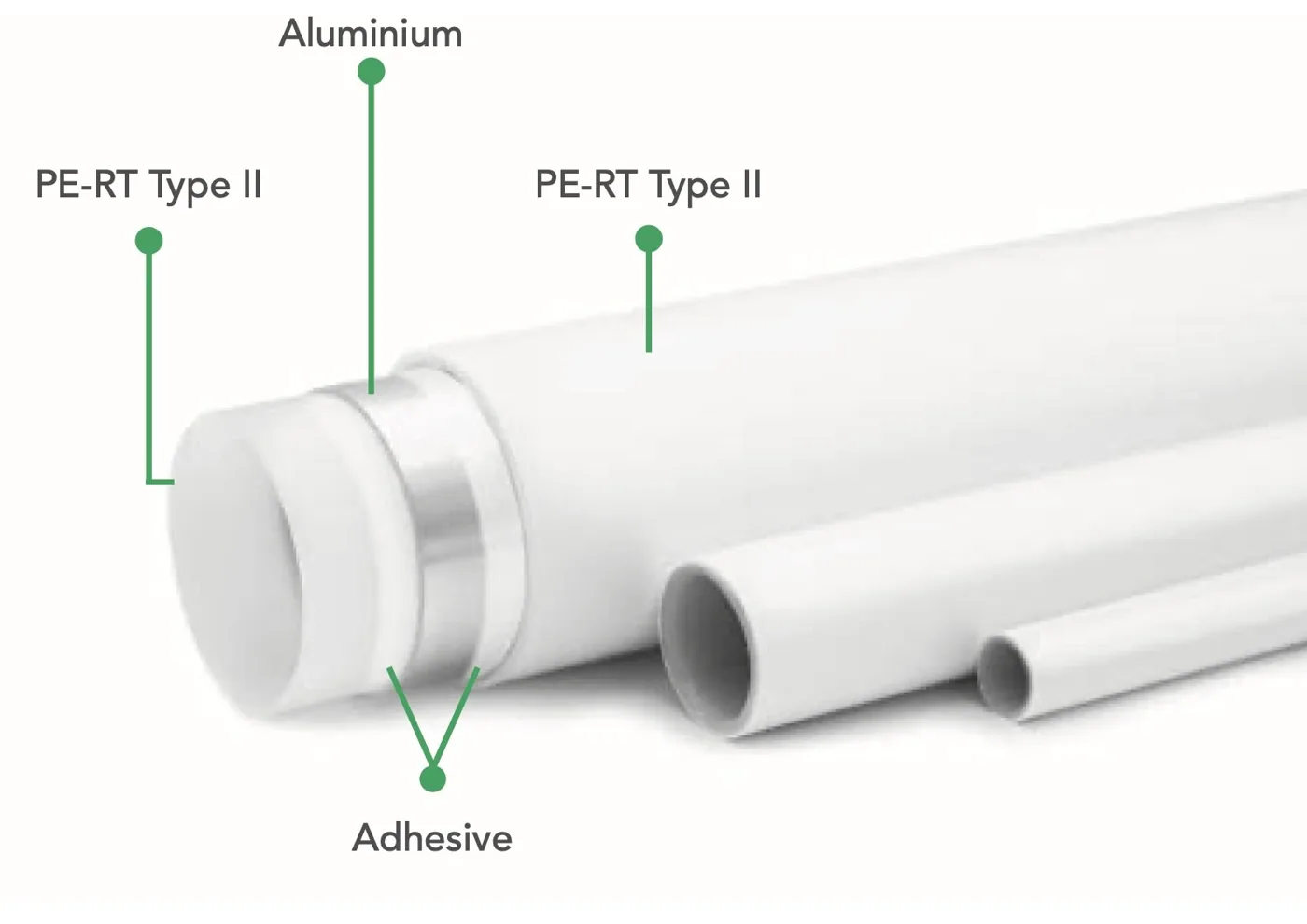 Multilayer pipe, 16-63 mmCoils up to 32 mm for long runs with no joints in the wall.
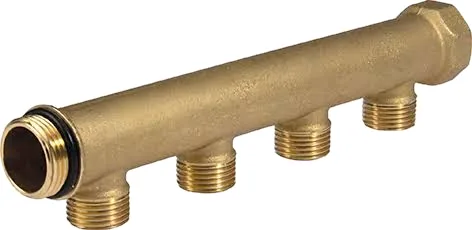 Brass manifoldsOne line to every bathroom.
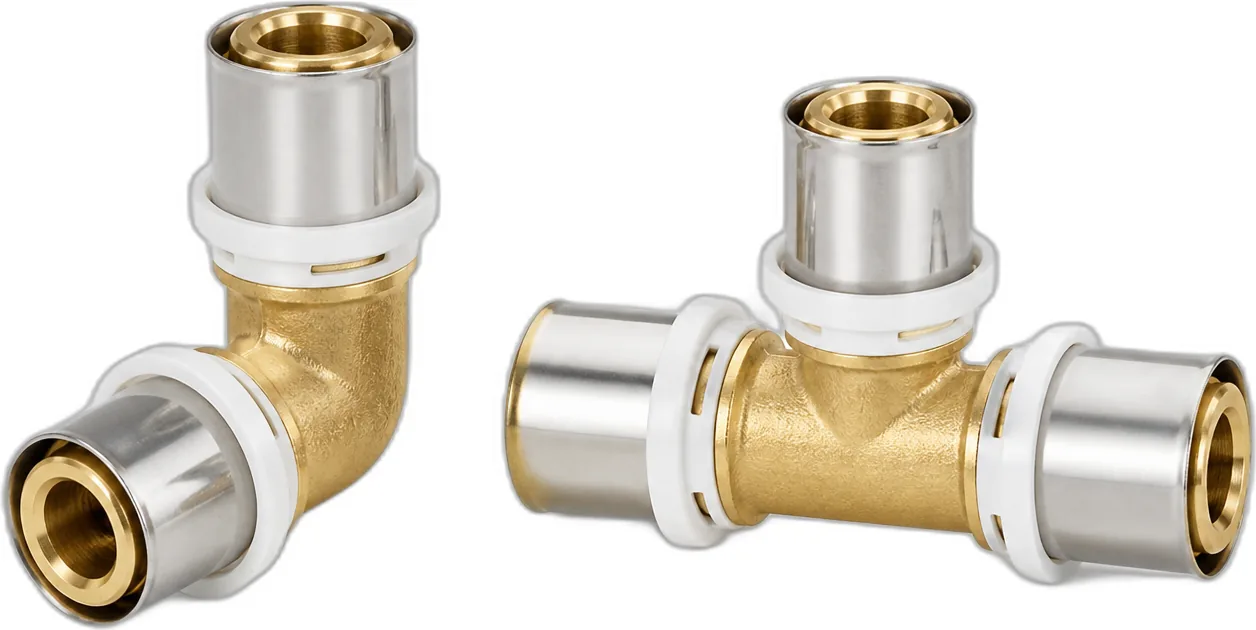 Brass press fittingsElbows, tees and adaptors.
Flow shown at 1.5 m/s, a common design speed for quiet supply lines. Water held per metre is the cold water that must run off before hot arrives. Planning guide only - final sizes depend on pressure, pipe length and how many points run at once.
PE-RT / AL / PE-RT: best or equal-best on every line.
| GHP+ PE-RT / AL / PE-RT | PEX / AL / PEX | CPVC | GI (galvanised iron) | |
|---|---|---|---|---|
| Plastic layers | ✓PE-RT type II - performs as made, no cross-linking step | ✕PEX - needs a cross-linking step; quality depends on how well it is cross-linked | ✕Chlorinated PVC, rigid | ✕Steel with a zinc coat |
| Joints | ✓Pressed brass, inspection window; pressure-test straight away | =Press fittings | ✕Solvent cement - wait for it to cure before testing | ✕Threaded with tape or hemp - leak-prone |
| Installing | ✓Flexible: uncoils and bends easily by hand or tool, then holds its shape | ✕Holds its shape, but a stiffer pipe to uncoil and bend (typical) | ✕Rigid - a fitting at every turn | ✕Rigid - heavy, a fitting at every turn |
| Expansion (mm/m.°C) | ✓0.026 - the aluminium core holds it | =about the same - aluminium core | ✕about 0.06-0.07 (typical) | ✕about 0.012 - but rusts |
| Oxygen barrier | ✓Yes - laser-welded aluminium | =Yes - aluminium | ✕No | ✕Rusts on the inside |
| Inside wall over the years | ✓0.007 mm smooth - no scale, no corrosion | =Smooth | =Smooth | ✕Rust and scale narrow the bore |
| Cold and knocks | ✓Tough; works from -40 °C, laid down to -10 °C | =Tough | ✕Brittle in the cold; cracks on impact | =Tough |
| Hot water rating | ✓70 °C at 10 bar; 95 °C short-term; 80 bar burst | =Similar rating | ✕Pressure rating falls as temperature rises (typical) | ✕Hot water speeds up corrosion |
| End of life | ✓PE-RT is a thermoplastic - 100 % recyclable | ✕Cross-linked PEX cannot be re-melted | ✕Limited recycling | =Recyclable |
| Best or equal-best | 9 of 9 | 6 of 9 | 1 of 9 | 2 of 9 |
- PE-RT type II needs no cross-linking - consistent quality straight from the extruder
- More flexible - quicker to uncoil, bend and fix on site
- A thermoplastic: 100 % recyclable at end of life
- No solvent glue, no fumes, no curing wait before the pressure test
- Bends instead of a fitting at every corner - fewer joints, fewer leak points
- Does not turn brittle in a cold winter or crack when knocked
- Never rusts - clean water, no brown first flush
- The bore stays full size; no scale build-up
- Light: a coil carried by one person, no threading on site
GHP+ multilayer figures from the HELIROMA HELIKLIMA datasheet. Figures for PEX/AL/PEX, CPVC and GI are typical values for those materials, for comparison only; individual brands vary. ✓ best, = equal-best, ✕ weaker.
Insulated pipe: hot stays hot, cold stays dry.
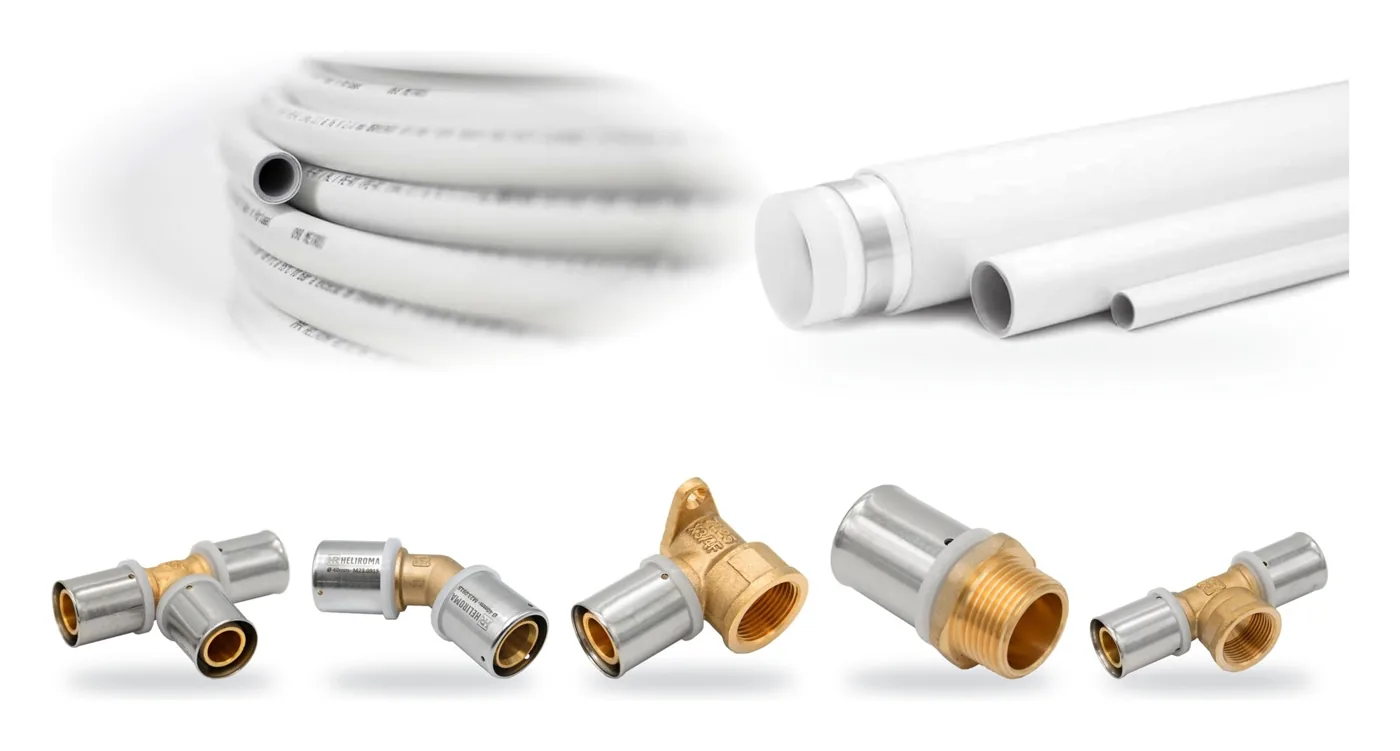
The same five-layer multilayer pipe, factory-sleeved in grey polyethylene foam (6 or 10 mm) and a red or blue film.
- Every hot line from the tank to the bathrooms
- Heat pump flow and return, between the unit and the tank
- Cold lines in false ceilings and near AC ducts, where they would sweat
- Exposed runs on terraces and shafts - the film is UV-protected
- Chilled-water lines from a GHP+ monoblock in summer
Worked from U = 2π / [ln(Do/Dp)/λ + 2/(h·Do)], with foam λ 0.037 W/m.K from the HELIROMA insulated datasheet and still-air h = 8.52 W/m²K; the pipe wall itself is ignored. A 20 m hot line held hot for 16 hours a day loses about 5.1 kWh bare and 2.5 kWh with 10 mm insulation.
Hot water at every tap, the moment you open it.
- Hot water at every tap within seconds - even the far bathroom
- No cold water run to waste - about 2 L every time on a 10 m line
- Hotels: guests get hot water at the first turn, every room, every floor
- Works with any tank and heat pump; one small pump does the whole house
- Mixers and thermostatic valves get steady hot water, so temperatures stay even
- A second pipe to lay and lag - plan it before plaster
- The loop loses heat all the time it runs - insulate it and run the pump on a timer or thermostat
- A small pump uses some power and needs a yearly check
- A loop left lukewarm can breed bacteria - keep the return at 50 °C or more
- An oversized pump is noisy and wears the pipe - size it to the loop
Water held per metre and heat loss from the pipe pages above (20 mm HELIKLIMA, 16 mm inside; 7.7 W/m with 10 mm insulation at 55 °C in a 25 °C room). Diagram is schematic - we draw the loop for your house from the plans.
Ask us about Hot-water plumbing: sizes, materials and tap-to-tap hot water
Send your plan or tell us the stage of construction. We reply on WhatsApp with options and a time to visit, usually the same day.